Our Language Program
The ESS offers a diverse language profile with both an English and a German language section. In accordance with the Language Policy of the European Schools and the European Schools curriculum, all pupils are required to learn three languages:
First Language (L1)
Native language
GE or EN
(P1 to S7)
Second Language (L2)
1st foreign language
EN, GE or FR
(P1 to S7)
Third Language (L3)
2nd foreign language
FR, SN, IT or EN
(S1 to S5/S7)
Important: The choice of L2 later also determines the language of instruction for a number of subjects.
Weekly Language Timetable

Language Proficiency Targets

How the Proportion of Teaching in a Foreign Language Increases
The language of the section (L1) is the main language of instruction at the European Schools. As pupils progress through their school career, however, certain subjects and areas of learning are also taught in their first foreign language (L2).
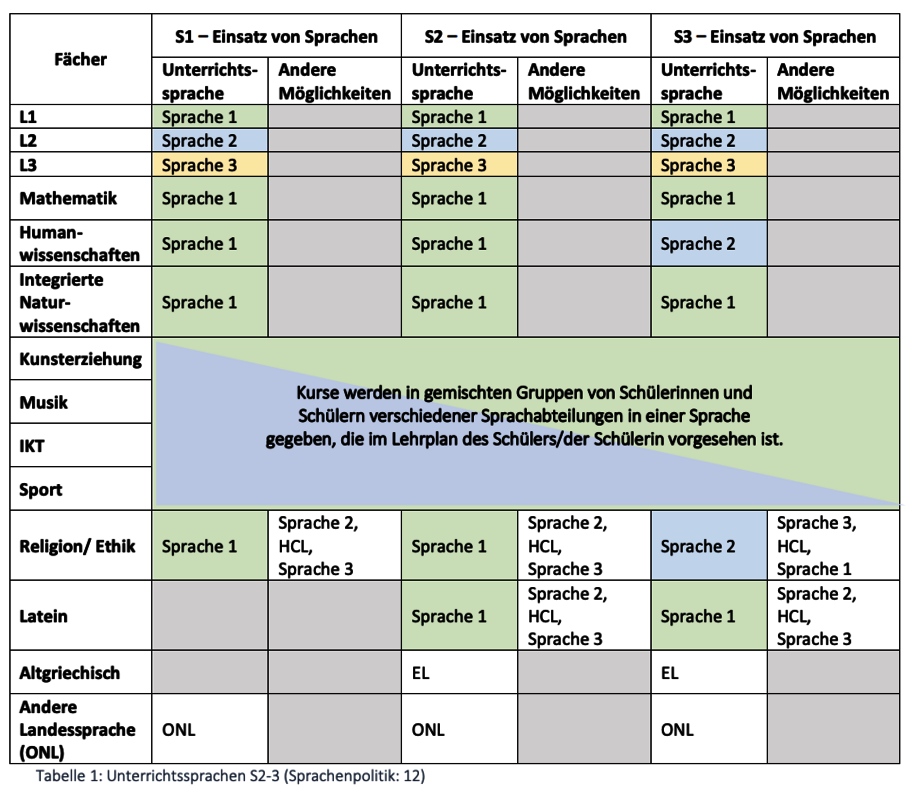
Cycle 1 · S1–S3
- Art, Music and Physical Education in mixed-section groups
- Human Sciences and Religion from S3 onwards in L2
- first intensive experience of learning subject content through a foreign language
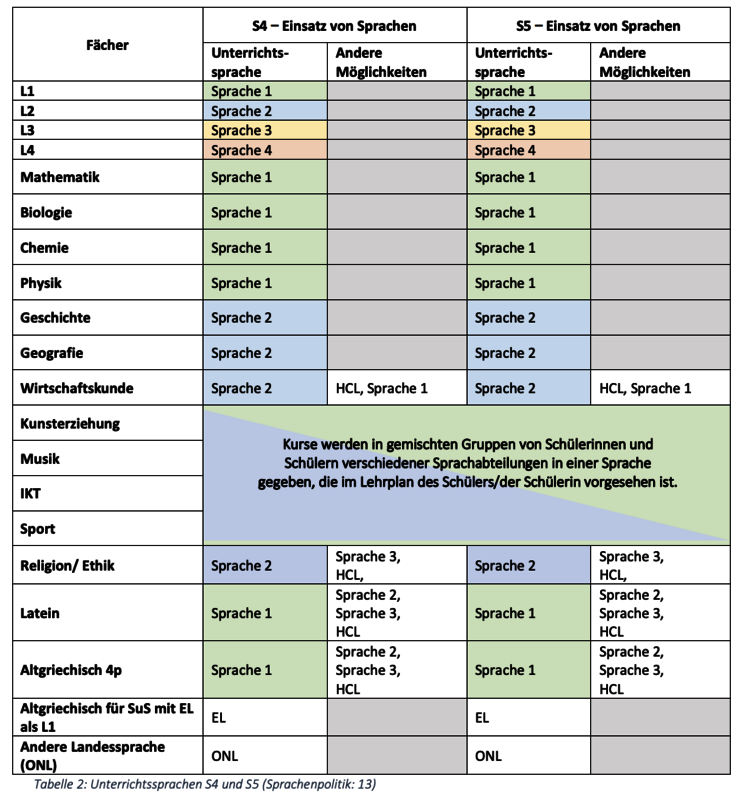
Cycle 2 · S4–S5
History, Geography and Economics in L2
an increasing proportion of non-language subjects taught through a foreign language
preparation for the upper secondary cycle
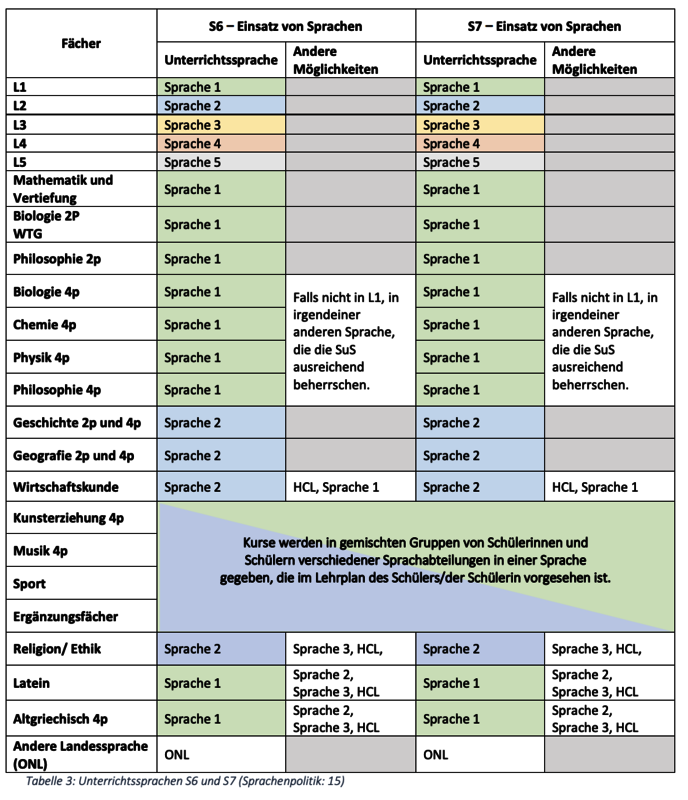
Cycle 3 · S6–S7
- continuation of multilingual subject teaching
- preparation for the European Baccalaureate in the foreign language
Teaching in a foreign language (CLIL)
At the ESS, subjects taught through a foreign language follow the principle of monolingualism. A central element of this approach is Content and Language Integrated Learning (CLIL).
CLIL combines the learning of subject content with language learning. In this way, it develops not only pupils’ language comprehension but also their ability to understand and discuss complex topics in a foreign language.
Language learning thus becomes an integral part of the entire educational process, allowing pupils to develop their language skills in a natural and effective way. Subjects such as Human Sciences, and later Geography and History, are taught through the first foreign language using the CLIL approach.
Assessment and the correction of language errors in CLIL lessons require a balanced approach, as the main focus is on subject content rather than language learning.
For example, language errors in assessed work are corrected but are not normally included in the mark, provided that the intended meaning remains clear despite the error. A distinction is therefore made between formal language errors such as grammar or spelling mistakes and misunderstandings that affect the subject content.
This approach promotes a positive learning environment in which language errors are regarded as an integral part of the learning process. Pupils therefore develop not only subject knowledge, but also confidence and autonomy in language learning.
What if my child does not yet speak a foreign language when entering P5?
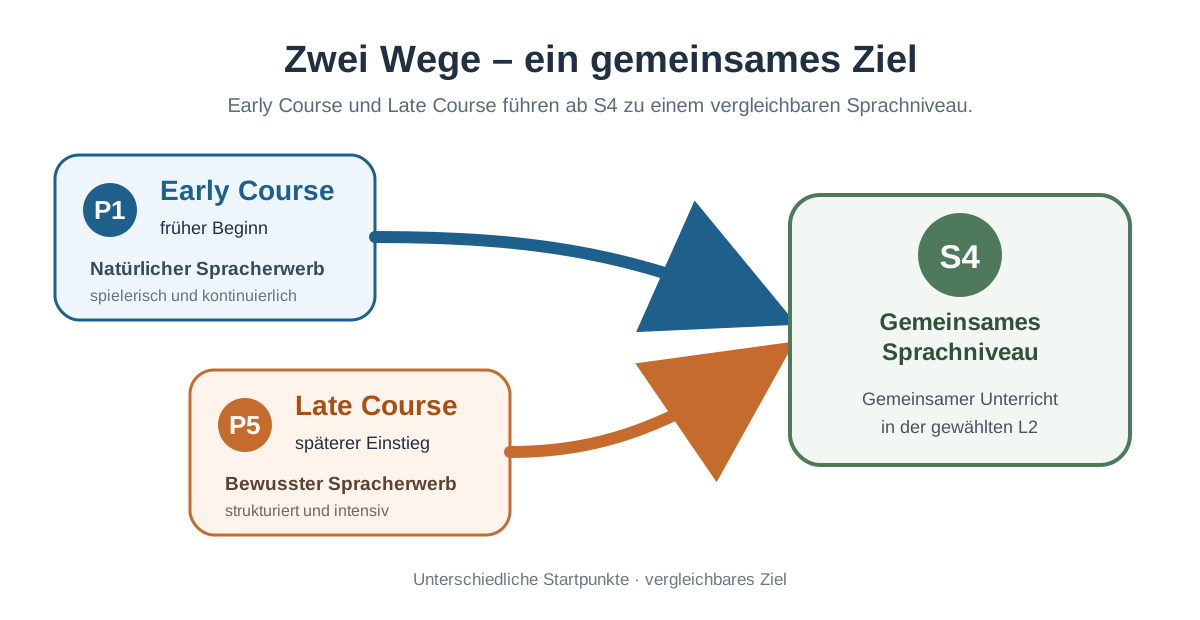
At the European School Saarland, L2 instruction begins either in P1 as part of the Early Course or in P5 as part of the Late Course for pupils who join the ESS in P5.
The Early Course focuses primarily on natural language acquisition, while the Late Course places greater emphasis on conscious and strategic language learning. This ensures that all learners can be taught together at a comparable level from S4 onwards. The two courses are initially taught separately and can be merged from S4 onwards.
This structure reflects current research findings: while younger children acquire languages more naturally but at a slower pace (Grotjahn, Schlak & Berndt, 2010), older pupils from around the age of ten tend to learn more efficiently and analytically (Krashen, Long & Scarcella, 1979; Muñoz, 2006).